Friday, August 31, 2012

American Kestrel, Still a Falcon But Not Related to Hawks Anymore!


Kestrels

  The American Ornithologists' Union (AOU) published its new checklist of North American birds with lots of changes! The most talked about in my circle is the repositioning of falcons. Long believed to be related to hawks, DNA evidence has now shown them to be closer relatives to parrots and songbirds (passerines)!
  According to the AUO site: "Parrots (Psittaciformes) and Passeriformes (Passerines) are are now believed to be each others' closest relatives, and sister to Falcons & Caracaras (Falconiformes). Believe it or not, hawks (Accipitriformes) are not closely related to falcons, despite the apparent similarity, and falcons are technically closer to Ruby-crowned Kinglet or House Sparrow!"

female Kestrel
 In Vermont, our falcons include kestrel, merlin, peregrine and the very rare gyrfalcon. We've been counting migrating nighthawks (not hawks either but this isn't new) and Gerry captured some great pictures of the resident kestrels.

kestrel
I'm sure we'll continue to count falcons along with the hawks and other birds of prey when we participate in the Putney Mountain Hawkwatch starting in a few days.
kestrel
Stayed tuned for more pictures of our Maine trip!

Wednesday, August 22, 2012

Common Nighthawk - or is it a Kite?

Last night we counted over 200 Common Nighthawks migrating along the CT River in Westminster Station. Gerry was armed with his camera and took many shots as they flew by, some circling above us catching insects on the fly.

It wasn't until this morning when he sorted through the 100s of shots, that he noticed one bird with string hanging from her wing and tail. None of us watching the nighthawks noticed one flying oddly or for that matter, one with string attached.

Is it fishing line? That seems like a strong possibility. Luckily for this bird it didn't affect her flight on this night.
click on the pictures for a closer look.

Sunday, August 19, 2012

Common Nighthawk Migration

Common Nighthawk - male
   It's that time of year when Common Nighthawks are starting to migrate to their winter homes in South America. This bird has one of the longest migration routes of any North American migrant. We have our favorite spot in Westminster Station to watch the birds as they fly south following the path of the Connecticut River. Dusk is the best time to catch them flying in small flocks.

Common Nighthawk - female
     They are not hawks, but members of the nightjar family, which includes the whip-poor-will. These night-flying, aerial insectivores have large mouths with bristles that helps them catch insects. This night, a flock of about 10 birds flew directly overhead, circling around and around, gleaning insects.

     There has been a general decline in the number of Common Nighthawks in North America. They don't build a nest, instead, laying eggs on bare ground (sand, dirt, gravel or rock) or flat roofs (made with gravel) in urban settings. Reasons for the decline could include habitat loss, pesticide use and migration hazards. In cities, changes in roofing substrate may be a factor

Friday, August 3, 2012

Birding Allen's Marsh


glossy ibis
A Glossy Ibis had been spotted at Allen's Marsh in Westminster.........the day I left for a trip!
Common in marshes along the Atlantic coast, we don't see many in Vermont. So as soon as I returned, Gerry and I raced down to the marsh, but we dipped (birding slang for missing the bird you're after). The next morning we returned again only to dip again. But perseverance prevails! We went back about 6 pm.and shortly after, this first-fall ibis flew in.

glossy ibis
Marsh Wren
Another unusual bird for this marsh, surprisingly, is the marsh wren! They were pretty vocal and we sighted a couple working their way in the grasses.

Virginia Rail
Virginia Rails are pretty common in marshes but rarely seen. Two were "talking" to each other last night, "kidik kidik" and the other would answer "kidik kidik".  They were right next to the road and even though they were really loud, they blended in so well, it took a while to finally see them.

American Black Ducks
synchronized flying!
the avian Olympics!
Green Heron
Great Blue Heron
huge flock of European Starlings


Saturday, June 30, 2012

Bird Nests, Houses and Cavities

Baltimore Oriole nest
Being a weaver, bird nests have always fascinated me. I love how birds use natural and man-made materials to build these amazing structures. This Oriole nest looks like it's attached precariously to a branch.

Baltimore Oriole at nest
The female of this species does the nest building, usually going back to the same area as in previous years, but not re-using the old nest. She will take material from a former nest to use in the her new one.

Bald Eagle nest

Bald Eagles build the largest nests or aeries of any North American bird. They will use the same nest year after year, adding material to it. Typically the nest is 5 feet across but may eventually be 13 ft deep and 8 feet wide, weighing 1 ton. One nest in Florida was found to be 20 ft.deep, 9.5 ft. wide and weighed 2.7 tons. This is the largest tree nest ever known.

Blue-gray Gnatcatcher
While observing a Gnatcatcher this spring, we followed her to the nest. It was well camouflaged with lichens covering the outside, mirroring the lichens covering the bark on the cherry tree where the nest was built.

Eastern Kingbird nest
This Kingbird was sitting pretty on her nest. The Kingbird is one of a few who will eject Brown-headed Cowbird eggs from the nest. Cowbirds don't build their own nests but parasitize other nests.

Red-eyed Vireo with nesting material

On a hike in the woods, we heard Red-eyed Vireos singing and saw this one with nesting material.

Red-eyed Vireo nest
We followed her and found the nest she was building in the fork of a branch.

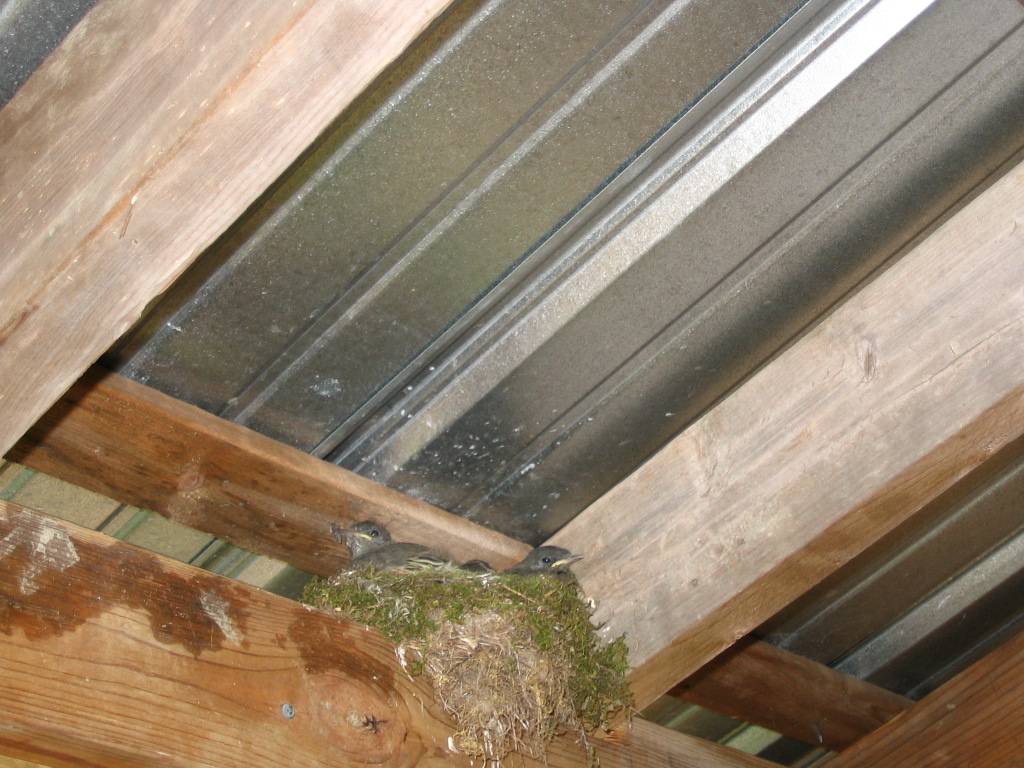
Eastern Phoebe nest with young
The female Eastern Phoebe will build her nest on a sound structure, usually in a site protected from the weather. Phoebes will often re-use the same nest the following year.

American Robin nest with young
A female robin will often build her nest in unlikely spots but to her, it must have seemed a safe spot. Robins can have up to 3 broods in a year.

House Wren defending his nest site
House Wrens may be small but they are fierce defenders of their nest boxes. I observed one this spring relentlessly attacking a chipmunk until the chipmunk left the area. Every time I go outside, I too, get scolded.

Northern Flicker at nest hole
Both male and female Flickers excavate their nest cavity in a dead tree.

Tree Swallow in nest cavity
Even though we usually see Tree Swallows in houses around the edges of marshes and fields, they will nest in tree cavities. Unable to excavate cavities, they will use existing holes or natural cavities.

Tree Swallow in gourd-type house
Our Tree Swallows come back every year to nest in these gourd-type houses we put up in our field.

Eastern Bluebird feeding nestling


Our Eastern Bluebirds successfully fledged one brood, then started another in a different house. One day,  realizing I hadn't seen the bluebirds lately,  I looked at the house and saw 2 heads sticking out...........not baby bluebirds...............but..........

field mice
Field Mice!! How did they get into the house!?! I really don't want to think about it........

Tuesday, June 19, 2012

Wonderful Warblers - and How They Got their Names!

yellow-rumped warbler
   This isn't a picture of the Yellow-rumped Warbler's rump, it's a picture of the undertail coverts which are white. When I decided to blog about how warblers got their names, I found that Gerry didn't get a shot of the Yellow-rumped Warbler's rump, but I included the bird anyway. Take my word for it, it's yellow.

yellow-rumped warbler

There are two subspecies of the Yellow-rumped Warbler. Our eastern variety, the Myrtle, has a white throat whereas the western one, Audubon's, has a yellow throat. They both have yellow rumps; some birders call them "butter butts".

yellow warbler
The Yellow Warbler IS yellow; there are no wing bars, no eye rings or head streaking. They are uniformly yellow; the males are egg-yolk yellow with reddish streaks on their chests.

chestnut-sided warbler
The Chestnut-sided Warbler male is a well-named warbler for he does have chestnut-colored sides but the females and fall males do not. This warbler was virtually unreported during the time of Audubon and other early American naturalists, but has increased greatly in numbers since the clearing of eastern forests in the 1800’s. This is a bird of second growth, scrub and disturbed woodlands throughout its breeding range in North America.

blue-winged warbler
While the Blue-winged Warbler doesn't have sky blue wings (from a distance the wings look gray), in fact upon closer inspection they are slate-blue, with a tail to match.

magnolia warbler
This beautiful warbler with the black necklace was first discovered in magnolia trees in the 19th century by famed ornithologist Alexander Wilson while in Mississippi, thus its name. Although Alexander Wilson did call it a Black-and-yellow Warbler, its Latin name is Dendroica magnolia, so Magnolia Warbler stuck.

American redstart
The American Redstart got its name from the red patches on his tail and "start" comes from Middle English stert for tail. The intensity of the reddish-orange patches in the tail, wings and sides of the breast can vary. Gerry says it should be called the American Orange-start.

pine warbler
True to his name, the Pine Warbler is found in pine trees! This species only nests in pine forests, and is almost never found in deciduous forests except during migration. The Pine Warbler is the only warbler that eats large quantities of seeds, primarily those of pines. Truly living up to his name.

black-and-white warbler
Another aptly named warbler, the Black-and-white is commonly found foraging for insects while creeping along the trunks and branches of trees. This warbler has a very distinctive song. Imagine a squeaky wheel going around and around and you've got it; weesee, weesee, weesee..........

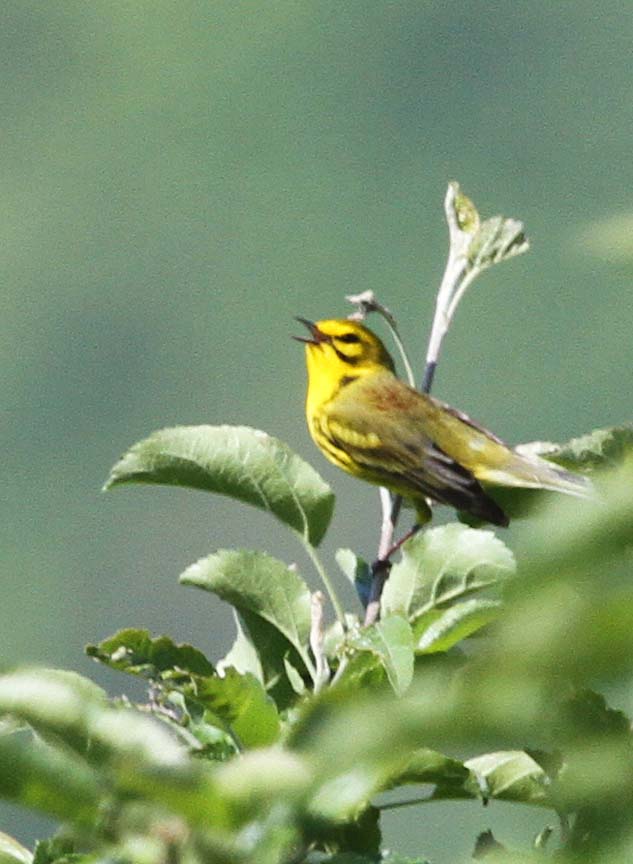
prairie warbler
The prairie warbler got its name in 1810 in south-central Kentucky when ornithologist Alexander Wilson first encountered the bird in scrubby habitat that today, we call a barrens. In 1810, these savanna-like barrens with scattered trees and a brushy understory were called prairies. Today you'll find a Prairie Warbler in shrubby fields, early regenerating forests, and other successional habitats, like power-line clearings and christmas tree farms.

common yellowthroat
I think the Common Yellowthroat should have been named the Masked Warbler! Sure both sexes have yellow throats but so do other warblers and there is a Yellow-throated Warbler already.........well no one asked me! The Common Yellowthroat is common though, probably the most widespread warbler in North America.  A recent study showed that males with large black masks were more likely to win mates than males with small black masks. I guess size does matter...............in the bird world.

Tuesday, June 12, 2012

Rose-breasted Grosbeak

rose-breasted grosbeak
 The Rose-breasted Grosbeak is a pretty regular visitor at our house here in southeastern Vermont. This year we've seen 2 adults males and 2 adult females. There's no mistaking the male when it comes to identification - massive bill, black and white pattern and distinctive red patch on the breast.

female red-breasted grosbeak
The female is a bit drabber, looking like a large sparrow or finch. She has lemon-yellow feathers under her wings which are only visible in flight.

As I was looking at the images Gerry took of the male, I noticed something green in the corner of his bill.

A few frames later and you could get a better glimpse of........

I assume it's a caterpillar, or was a caterpillar. Besides using those massive bills for cracking sunflower seeds, grosbeaks also eat insects. 

 I'm sure both pairs are busy feeding young. Here's an interesting fact I found on the Cornell site - 'the nest of the Rose-breasted Grosbeak is so thinly constructed that eggs often can be seen from below through the nest'. We'll have to start looking!