Showing posts with label Vermont. Show all posts

Friday, August 31, 2012

American Kestrel, Still a Falcon But Not Related to Hawks Anymore!


Kestrels

  The American Ornithologists' Union (AOU) published its new checklist of North American birds with lots of changes! The most talked about in my circle is the repositioning of falcons. Long believed to be related to hawks, DNA evidence has now shown them to be closer relatives to parrots and songbirds (passerines)!
  According to the AUO site: "Parrots (Psittaciformes) and Passeriformes (Passerines) are are now believed to be each others' closest relatives, and sister to Falcons & Caracaras (Falconiformes). Believe it or not, hawks (Accipitriformes) are not closely related to falcons, despite the apparent similarity, and falcons are technically closer to Ruby-crowned Kinglet or House Sparrow!"

female Kestrel
 In Vermont, our falcons include kestrel, merlin, peregrine and the very rare gyrfalcon. We've been counting migrating nighthawks (not hawks either but this isn't new) and Gerry captured some great pictures of the resident kestrels.

kestrel
I'm sure we'll continue to count falcons along with the hawks and other birds of prey when we participate in the Putney Mountain Hawkwatch starting in a few days.
kestrel
Stayed tuned for more pictures of our Maine trip!

Friday, August 3, 2012

Birding Allen's Marsh


glossy ibis
A Glossy Ibis had been spotted at Allen's Marsh in Westminster.........the day I left for a trip!
Common in marshes along the Atlantic coast, we don't see many in Vermont. So as soon as I returned, Gerry and I raced down to the marsh, but we dipped (birding slang for missing the bird you're after). The next morning we returned again only to dip again. But perseverance prevails! We went back about 6 pm.and shortly after, this first-fall ibis flew in.

glossy ibis
Marsh Wren
Another unusual bird for this marsh, surprisingly, is the marsh wren! They were pretty vocal and we sighted a couple working their way in the grasses.

Virginia Rail
Virginia Rails are pretty common in marshes but rarely seen. Two were "talking" to each other last night, "kidik kidik" and the other would answer "kidik kidik".  They were right next to the road and even though they were really loud, they blended in so well, it took a while to finally see them.

American Black Ducks
synchronized flying!
the avian Olympics!
Green Heron
Great Blue Heron
huge flock of European Starlings


Saturday, June 30, 2012

Bird Nests, Houses and Cavities

Baltimore Oriole nest
Being a weaver, bird nests have always fascinated me. I love how birds use natural and man-made materials to build these amazing structures. This Oriole nest looks like it's attached precariously to a branch.

Baltimore Oriole at nest
The female of this species does the nest building, usually going back to the same area as in previous years, but not re-using the old nest. She will take material from a former nest to use in the her new one.

Bald Eagle nest

Bald Eagles build the largest nests or aeries of any North American bird. They will use the same nest year after year, adding material to it. Typically the nest is 5 feet across but may eventually be 13 ft deep and 8 feet wide, weighing 1 ton. One nest in Florida was found to be 20 ft.deep, 9.5 ft. wide and weighed 2.7 tons. This is the largest tree nest ever known.

Blue-gray Gnatcatcher
While observing a Gnatcatcher this spring, we followed her to the nest. It was well camouflaged with lichens covering the outside, mirroring the lichens covering the bark on the cherry tree where the nest was built.

Eastern Kingbird nest
This Kingbird was sitting pretty on her nest. The Kingbird is one of a few who will eject Brown-headed Cowbird eggs from the nest. Cowbirds don't build their own nests but parasitize other nests.

Red-eyed Vireo with nesting material

On a hike in the woods, we heard Red-eyed Vireos singing and saw this one with nesting material.

Red-eyed Vireo nest
We followed her and found the nest she was building in the fork of a branch.

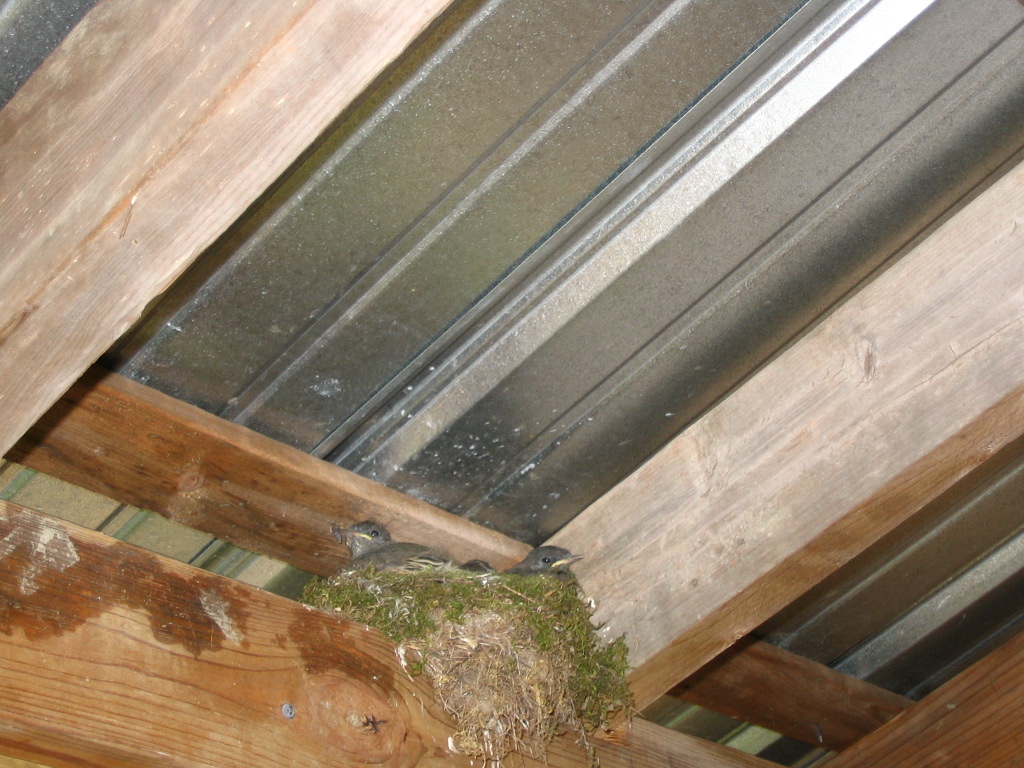
Eastern Phoebe nest with young
The female Eastern Phoebe will build her nest on a sound structure, usually in a site protected from the weather. Phoebes will often re-use the same nest the following year.

American Robin nest with young
A female robin will often build her nest in unlikely spots but to her, it must have seemed a safe spot. Robins can have up to 3 broods in a year.

House Wren defending his nest site
House Wrens may be small but they are fierce defenders of their nest boxes. I observed one this spring relentlessly attacking a chipmunk until the chipmunk left the area. Every time I go outside, I too, get scolded.

Northern Flicker at nest hole
Both male and female Flickers excavate their nest cavity in a dead tree.

Tree Swallow in nest cavity
Even though we usually see Tree Swallows in houses around the edges of marshes and fields, they will nest in tree cavities. Unable to excavate cavities, they will use existing holes or natural cavities.

Tree Swallow in gourd-type house
Our Tree Swallows come back every year to nest in these gourd-type houses we put up in our field.

Eastern Bluebird feeding nestling


Our Eastern Bluebirds successfully fledged one brood, then started another in a different house. One day,  realizing I hadn't seen the bluebirds lately,  I looked at the house and saw 2 heads sticking out...........not baby bluebirds...............but..........

field mice
Field Mice!! How did they get into the house!?! I really don't want to think about it........

Thursday, June 7, 2012

Great Blue Heron

   At 4 feet tall with a 6 foot wingspan, the Great Blue is our largest North American heron. 

Great Blues have specialized feathers on their chest that continually grow and fray. They comb this “powder down” with a fringed claw on their middle toe, using the down like a washcloth to remove fish slime and other oils from their feathers as they preen.

This Great Blue seems to like the birdhouses at Allen's marsh in Westminster. We saw him atop this perch quite frequently. 

Although he looks like he might collapse the house, a Great Blue weighs only 5 to 6 pounds. 

Most times when you see them flying, the heron's neck is in an S-shape, this improves its aerodynamics.

Here's a good shot of him all stretched out.

You can really get an idea of the length of those wings in this picture!

Although he looks like a flasher, this behavior is simply called "sunning". It was late afternoon, the sun was setting and he's gathering the last warm rays. Springtime in Vermont!

Sunday, June 3, 2012

Backyard Barred Owl


barred owl
   Also known as the "hoot owl", we have two barred owls in our neighborhood. We can hear the familiar "who cooks for you, who cooks for you all" hooting at night as well as in the daytime. Barred owls have many calls, including one sounding like raucous monkeys. The male's voice is said to be deeper and mellower than the female but I can't tell the difference.

is that a vole in your mouth?

   Even though this owl is well camouflaged, it seems whenever we're near, he silently glides away. It might have something to do with the fact that our hikes in the woods are accompanied by three rambunctious dogs who love to chase squirrels. 

  Owls have specialized feathers with fringes of varying softness the help muffle sound when they fly. Their broad wings and light bodies also make them nearly silent fliers, which helps them stalk prey more easily.

   This day we spotted him with a vole. A Barred Owl will use a perch, from where he dives upon its prey - meadow voles are his favorite, followed by shrews and deer mice. Others include rats, squirrels, young rabbits, bats, moles, opossums, mink, and weasels. Birds are taken occasionally, including woodpeckers, grouse, quail, jays, blackbirds, and pigeons. They also eats small fish, turtles, frogs, snakes, lizards, crayfish, scorpions, beetles, crickets, and grasshoppers.

   Owls have zygodactyl feet with two toes pointing forward and two toes pointing backward. This gives the birds a stronger, more powerful grip so they can be more effective predators. 
  
   Watching a predator eat its prey is not for the feint of heart. He'll eat every part of his catch and later regurgitate a pellet of indigestible material such as the bones and fur.

An owl has three eyelids: one for blinking, one for sleeping and one for keeping the eye clean and healthy. Not sure what one he's using here.

An owl's eyes are supported by bony eye sockets and they cannot turn their eyes. Instead, owls rotate their heads up to 270 degrees, but they cannot turn their heads all the way around. The barred owl is one of a few types who have dark brown eyes, most have yellow eyes.


Friday, May 25, 2012

Birds Around the House

ruby-throated hummingbird
   We live in southeastern Vermont, surrounded by deciduous trees, conifers and open fields, our elevation is just below 1000 ft. I leave feeders up year round (more on the perils of this later in the post).

chipping sparrow with nesting material
   As soon as Gerry got his new camera (Canon EOS 7D with 100 - 400mm zoom) and started reading the manual, he began shooting. We're lucky to have a great spot for a nice variety of birds.

eastern bluebird
   For the second year, bluebirds have nested in a house, I can hear the nestlings squawking when I walk by.

tree swallow
   We always have tree swallows nesting.

house wren
   House wrens always return to their usual house.

pine siskin
   Two pine siskins have been around for a while, they usually head further north to breed. Not sure if they nested here though.

male red-bellied woodpecker

  New this year is a pair of red-bellied woodpeckers coming to our suet feeders everyday.

evening grosbeak
 Also a pair of evening grosbeaks returned, hopefully to nest. We rarely have them here at all.


Blue Jay

purple finch

scarlet tanager


   This was a rare treat, I kept hearing the tanager singing and hoped he'd come closer so Gerry could get a picture. I looked out the window and he was right on the bird bath.


   I know it's recommended to take the feeders down in the spring because of bears. I take them in at night and put them back out in the mornings, so I thought I had the bears fooled. Bears have a sense of smell that's 4 times better than a dog, so there's no fooling them. This guy arrived at 7pm.