|
| yellow-rumped warbler |
This isn't a picture of the Yellow-rumped Warbler's rump, it's a picture of the undertail coverts which are white. When I decided to blog about how warblers got their names, I found that Gerry didn't get a shot of the Yellow-rumped Warbler's rump, but I included the bird anyway. Take my word for it, it's yellow.
 |
| yellow-rumped warbler |
|
|
There are two subspecies of the Yellow-rumped Warbler. Our eastern variety, the Myrtle, has a white throat whereas the western one, Audubon's, has a yellow throat. They both have yellow rumps; some birders call them "butter butts".
 |
| yellow warbler |
The Yellow Warbler IS yellow; there are no wing bars, no eye rings or head streaking. They are uniformly yellow; the males are egg-yolk yellow with reddish streaks on their chests.
 |
| chestnut-sided warbler |
The Chestnut-sided Warbler male is a well-named warbler for he does have chestnut-colored sides but the females and fall males do not. This warbler was virtually
unreported during the time of Audubon and other early American naturalists, but has
increased greatly in numbers since the clearing of eastern forests in the 1800’s.
This is a bird of second growth, scrub and disturbed woodlands throughout its breeding
range in North America.
 |
| blue-winged warbler |
While the Blue-winged Warbler doesn't have sky blue wings (from a
distance the wings look gray), in fact upon closer inspection they are
slate-blue, with a tail to match.
 |
| magnolia warbler |
This beautiful warbler with the black necklace was first discovered in magnolia trees in the 19th century
by famed ornithologist Alexander Wilson while in Mississippi, thus its name. Although Alexander Wilson did call it a Black-and-yellow Warbler, its Latin name is Dendroica magnolia, so Magnolia Warbler stuck.
 |
| American redstart |
The American Redstart got its name from the red patches on his tail and "start" comes from Middle English stert for tail. The intensity of the reddish-orange patches in the tail, wings and sides of the breast can vary. Gerry says it should be called the American Orange-start.
 |
| pine warbler |
True to his name, the Pine Warbler is found in pine trees! This species only nests in pine forests, and is almost never found in deciduous forests except during migration. The Pine Warbler is the only warbler that eats large quantities of seeds, primarily those of pines. Truly living up to his name.
 |
| black-and-white warbler |
|
Another aptly named warbler, the Black-and-white is commonly found foraging for insects while creeping along the trunks and branches of trees. This warbler has a very distinctive song. Imagine a squeaky wheel going around and around and you've got it; weesee, weesee, weesee..........
 |
| prairie warbler |
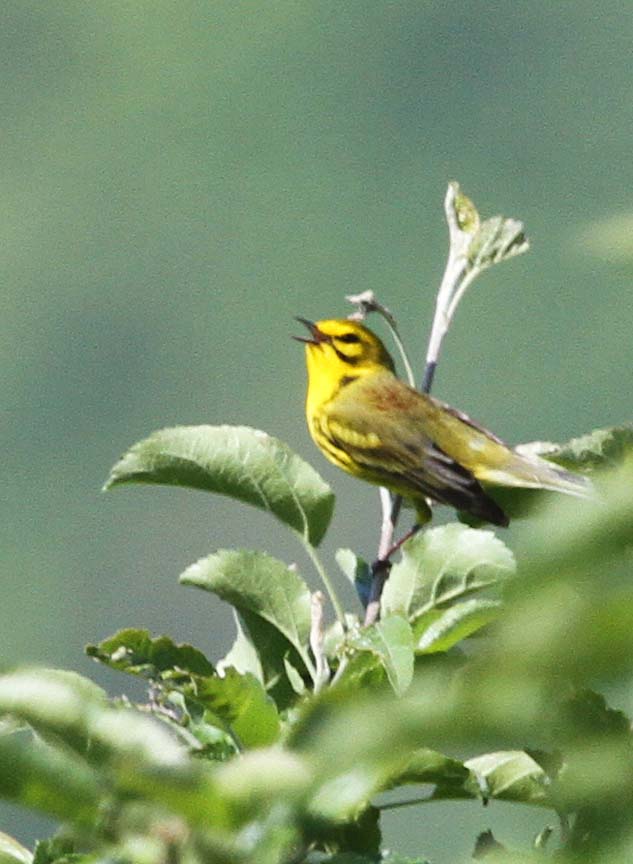
The prairie warbler got its name in 1810 in south-central Kentucky when
ornithologist Alexander Wilson first encountered the bird in scrubby
habitat that today, we call a barrens. In 1810, these
savanna-like barrens with scattered trees and a brushy understory were
called prairies. Today you'll find a Prairie Warbler in shrubby fields, early regenerating forests, and other successional habitats, like power-line clearings and christmas tree farms.
 |
| common yellowthroat |
I think the Common Yellowthroat
should have been named the Masked Warbler! Sure both sexes have yellow
throats but so do other warblers and there is a Yellow-throated Warbler
already.........well no one asked me! The Common Yellowthroat is common
though, probably the most widespread warbler in North America. A recent
study showed that males with
large black masks were more likely to win mates than males with small
black masks. I guess size does matter...............in the bird
world.