Showing posts with label warblers. Show all posts

Thursday, May 26, 2016

Recent Favorites

cerulean warbler
I can recall seeing my first cerulean warbler in college, at a cemetery, somewhere in Massachusetts. This recent sighting was the best view I ever had of one!

cerulean warbler
Cerulean warblers are usually found high up in the trees, flitting around constantly gleaning insects. We were pretty lucky this day that he found food in a shorter tree!

northern saw-whet owl
What a rare treat to have an owl, nest in a box in a easily viewed spot! So far two of these cute nestlings have been seen.

northern saw-whet owl
When we were there, he watched as cars and people walked and drove by. 

yellow-billed cuckoo

Saw this one fly in, a large bird, just bigger than a blue jay.

great crested flycatcher
You usually hear these birds before you see them, a very distinctive, very loud, upslurred WHEEP!

eastern wood-pewee
Easily identified by his song - peee-ah-weeeee!

indigo bunting
Nothing like the intense blue of this favorite!

warbling vireo
The song of the warbling vireo has a certain rhythm. Mnemonically it goes like this "if I see you, I will seize you, if I squeeze you, you will squirt". 

Canada warbler
Another pretty warbler that moves through our area on his way to breed in the north.

blue-winged warbler
Singing his beeee buzzzz song.

turkey vulture
Turkey vultures have an extraordinary sense of smell. They have been known to be able to smell carrion from over a mile away which is very unique in the bird world.


Tuesday, May 10, 2016

Spring Warblers

Yellow Warbler
 I have a new camera, got it the beginning of the year and I love it. It's the Nikon Coolpix P900, it has an amazing zoom and it's pretty easy to use. Most of the time I use the "birdwatching" mode, I have yet to switch to the advanced settings. I still can't figure out what f-stops do even though Gerry explains them all the time! I just want to point and shoot. This is a great time of year to bird in Vermont! Enjoy the warblers!!

Yellow-rumped Warbler

Yellow-rumps are among the first warblers to show up in the spring, they are everywhere, but most are migrating through.

Yellow-rumped Warbler

Palm Warbler (Yellow)
Palm warblers are early migrants too, first the yellow Palms arrive, followed by western Palms. Western Palms have whitish bellies.

Pine Warbler
You usually find Pine Warblers in pine trees! This one resides in our backyard.

Black-and-white Warbler
It's easy to find this warbler, he has a weezy weezy weezy song, sort of like a squeaky gate and he always scampers along the tree trunk and branches.

Common Yellowthroat
These warblers look like bandits, they sing a wichety wichety song and they like brushy areas near wetlands. They're pretty common at Herrick's Cove in Bellows Falls.

Black-throated Blue Warbler
This warbler is usually found in the woods. Both male and female have that white patch on the wing which is referred to as a handkerchief.

Yellow Warbler
Yellow warblers are so bright yellow, they really brighten up a dreary day and make you smile, especially as they sing "sweet, sweet, sweet, I'm so sweet!"
Most of these shots were taken at Herrick's Cove in Bellows Falls, in fact I've seen all these warblers and more there.


Monday, October 8, 2012

Mystery Warbler

mystery warbler
We went birding at Herrick's Cove in Bellows Falls, a great spot on the CT River and a designated IBA (important birding area). There were lots of birds -  lots of sparrows, lots of warblers. Warblers in the fall migrate through the area in waves, going tree to tree in pursuit of a quick meal. These groups are usually mixed with different varieties of warblers, vireos and other songbird migrants.

mystery warbler - another view
 I was pointing out the warblers and Gerry was taking pictures. When I first saw this one, I quickly dismissed it as a black-throated blue warbler. After Gerry downloaded the pictures and I went through them, I realized my mistake as the bird does not have the white eye-brow nor the white "handkerchief" on the wing of a black-throated blue! Ah, confusing fall warblers!! Gone are the bright breeding colors - we are left with warblers that appear bleached out.

view of the undertail coverts
So what is this warbler? Maybe a Tennessee warbler? It does look like an orange-crowned warbler but the undertail coverts should be yellow and this bird's are white. Note the broken eye-ring, dark line through the eye, no wing bars, sharp pointed bill and the white patch under the wing. As soon as the experts figure this out, I'll let you know! If you have any guesses or comments, I'd love to hear them!!

Tuesday, June 19, 2012

Wonderful Warblers - and How They Got their Names!

yellow-rumped warbler
   This isn't a picture of the Yellow-rumped Warbler's rump, it's a picture of the undertail coverts which are white. When I decided to blog about how warblers got their names, I found that Gerry didn't get a shot of the Yellow-rumped Warbler's rump, but I included the bird anyway. Take my word for it, it's yellow.

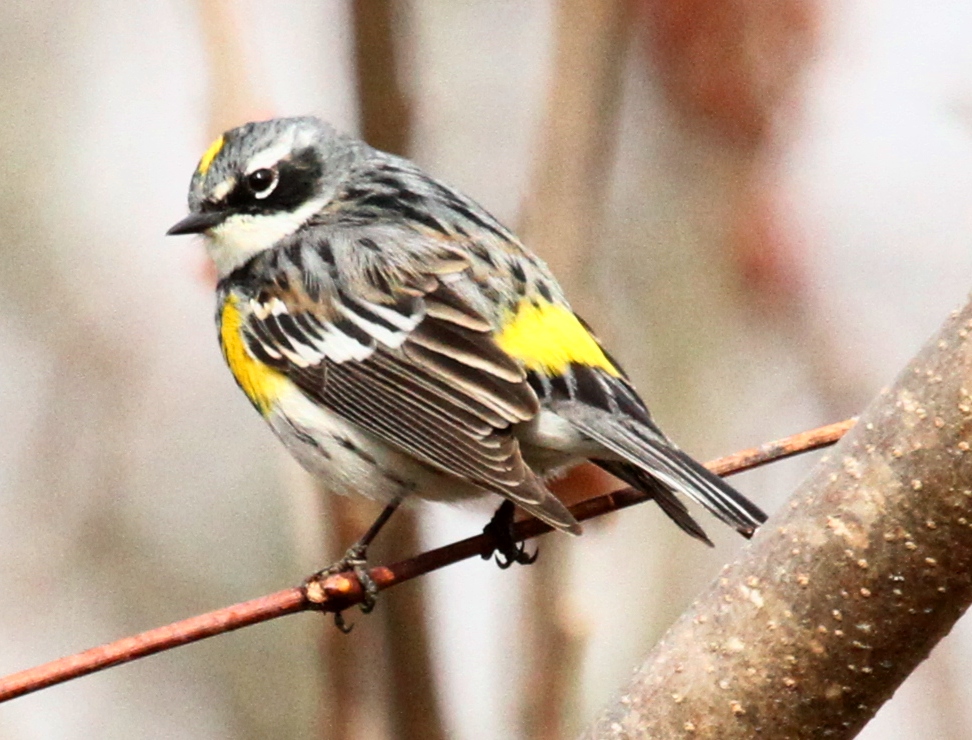
yellow-rumped warbler

There are two subspecies of the Yellow-rumped Warbler. Our eastern variety, the Myrtle, has a white throat whereas the western one, Audubon's, has a yellow throat. They both have yellow rumps; some birders call them "butter butts".

yellow warbler
The Yellow Warbler IS yellow; there are no wing bars, no eye rings or head streaking. They are uniformly yellow; the males are egg-yolk yellow with reddish streaks on their chests.

chestnut-sided warbler
The Chestnut-sided Warbler male is a well-named warbler for he does have chestnut-colored sides but the females and fall males do not. This warbler was virtually unreported during the time of Audubon and other early American naturalists, but has increased greatly in numbers since the clearing of eastern forests in the 1800’s. This is a bird of second growth, scrub and disturbed woodlands throughout its breeding range in North America.

blue-winged warbler
While the Blue-winged Warbler doesn't have sky blue wings (from a distance the wings look gray), in fact upon closer inspection they are slate-blue, with a tail to match.

magnolia warbler
This beautiful warbler with the black necklace was first discovered in magnolia trees in the 19th century by famed ornithologist Alexander Wilson while in Mississippi, thus its name. Although Alexander Wilson did call it a Black-and-yellow Warbler, its Latin name is Dendroica magnolia, so Magnolia Warbler stuck.

American redstart
The American Redstart got its name from the red patches on his tail and "start" comes from Middle English stert for tail. The intensity of the reddish-orange patches in the tail, wings and sides of the breast can vary. Gerry says it should be called the American Orange-start.

pine warbler
True to his name, the Pine Warbler is found in pine trees! This species only nests in pine forests, and is almost never found in deciduous forests except during migration. The Pine Warbler is the only warbler that eats large quantities of seeds, primarily those of pines. Truly living up to his name.

black-and-white warbler
Another aptly named warbler, the Black-and-white is commonly found foraging for insects while creeping along the trunks and branches of trees. This warbler has a very distinctive song. Imagine a squeaky wheel going around and around and you've got it; weesee, weesee, weesee..........

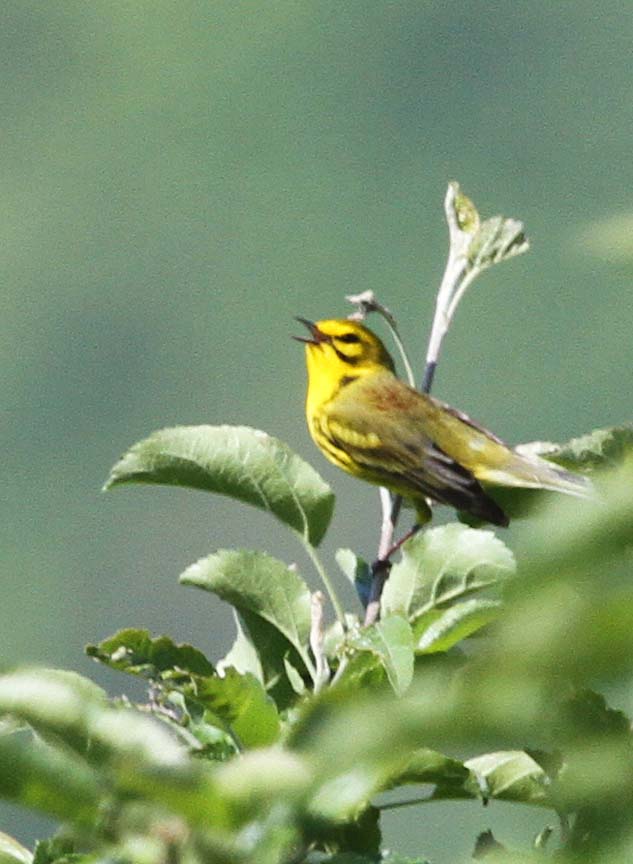
prairie warbler
The prairie warbler got its name in 1810 in south-central Kentucky when ornithologist Alexander Wilson first encountered the bird in scrubby habitat that today, we call a barrens. In 1810, these savanna-like barrens with scattered trees and a brushy understory were called prairies. Today you'll find a Prairie Warbler in shrubby fields, early regenerating forests, and other successional habitats, like power-line clearings and christmas tree farms.

common yellowthroat
I think the Common Yellowthroat should have been named the Masked Warbler! Sure both sexes have yellow throats but so do other warblers and there is a Yellow-throated Warbler already.........well no one asked me! The Common Yellowthroat is common though, probably the most widespread warbler in North America.  A recent study showed that males with large black masks were more likely to win mates than males with small black masks. I guess size does matter...............in the bird world.