Showing posts with label gnatcatcher. Show all posts

Tuesday, May 12, 2015

Warbler Walk


yellow warbler
Last Saturday, Gerry and I joined the southeastern Audubon group for a warbler walk led by Richard Foye. We walked along the Fort Hill Rail Trail, aka the Hinsdale setbacks, in New Hampshire. It's a great spot for migrating birds along the Connecticut River.

Richard telling the group about the bird we're hearing - now we need to find it!
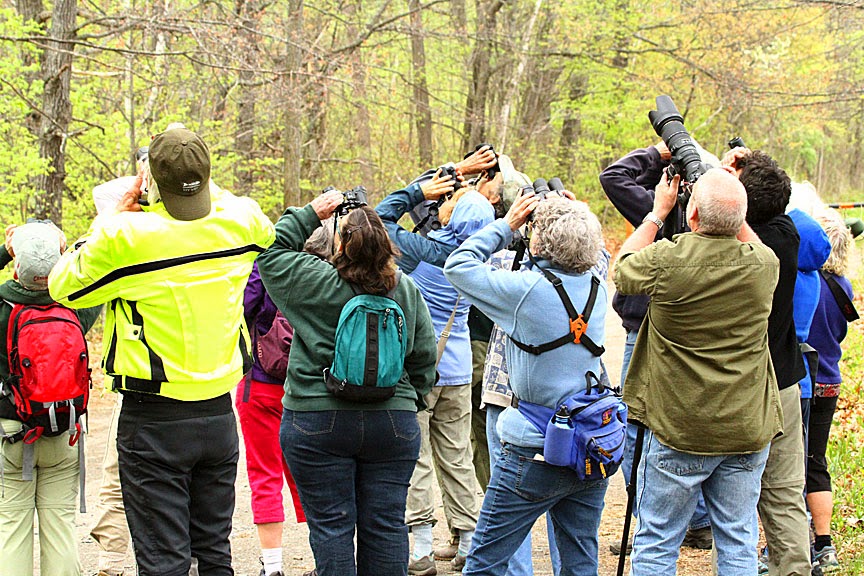
Warblers are always high in the trees!

 Our most common warbler of the day was the yellow-rumped warbler. We must have seen 50 or more!

The common yellowthroat is another very abundant warbler.. This is the female, the males are usually the ones seen, since they make the most noise singing! wichety wichety wichety!

Another warbler usually found near water is the yellow warbler, even on an overcast day, this warbler is as bright as the sun. He sings "sweet, sweet, sweet, I'm so sweet!"

A very good find was this singing, yellow-throated vireo.

The yellow-throated vireo showing off his color!


We also found a pair of blue-gray gnatcatchers building a nest. They use spiderwebs on the outside and add lichen. Once it's finished, it's well camouflaged.

gray catbird    


savannah sparrow

common grackle

northern rough-winged swallow
There was lots of bird activity on our walk, we enjoyed many species, not only warblers. We found 8 warbler species without too much trouble; yellow, yellow-rumped, black-and-white, northern parula, blackpoll, northern waterthrush, common yellowthroat and American redstart.
 

Saturday, May 17, 2014

Blue-Gray Gnatcatchers at Their Nest

We happened to see blue-gray gnatcatchers at their nest and Gerry got some great shots. Here's some interesting facts I found on Cornells's site, All About Birds.

Both sexes cooperate in building the neat, open, cuplike nest. They take up to two weeks to build the 2–3-inch wide nest, which is held together and attached to its branch with spider webbing and decorated with lichen.

 The nest's high walls are built in flexible layers. The main structural layer is built of fibrous materials like plant stems, bark strips, and grasses, all held together by spiderweb or caterpillar silk.

Inner layers become progressively finer, and the roughly 1.5-inch-wide cup is lined with plant down, paper, cocoons, hair, or feathers.

The outside is covered with webbing or silk decorated with bits of lichen or bark flakes.

  They often build a series of nests during a summer to counteract the effects of predation, mite infestations, or cowbird parasitism.
 Materials from earlier nests are frequently recycled to build later nests, which may be why they are usually completed more quickly than first nests.

 The male often builds second nests nearly solo, with the female finishing the inside of the first nest with softer materials.

 time for a break!!


Saturday, May 10, 2014

Spring at Herrick's Cove

Baltimore Oriole

 Finally spring has arrived, the weather's been warmer and the birds are returning to Herrick's Cove in Bellows Falls!. It's nice to see the bright colors of the Baltimore orioles!

Gray catbirds are now everywhere and chatting up a storm! Here's a good look at his rusty red undertail coverts.

gray catbird


Blue-gray gnatcatchers are very small birds with long tails which they flick from side to side. They are always in constant motion.  

yellow-throated vireo


The best bird of the day was a pair of yellow-throated vireos. They were so close to us, Gerry had a hard time getting a picture in focus with his zoom lens! 

Another bird Gerry has been after for a good picture, this female pileated woodpecker was very cooperative today!

An immature bald eagle was keeping watch along the Williams River. One can never see enough of these majestic birds!