Monday, May 26, 2014

American Bittern Courtship

While scanning the marshes at Herrick's Cove in Bellows Falls, I saw a bittern with white feathers!! I realized he was doing a courtship display for the female!!

The pictures were taken through my spotting scope with my Canon PowerShot, so the quality is not good. But I read on the Audubon website that "the bittern has a remarkable, though rarely seen, courtship display" so I decided to share the pictures anyway.

Audubon goes on to say "the male arches his back, exposing whitish plumes, shortens his neck, dips his breast forward, and "booms" at the female."

 He followed her through the grasses and eventually I lost sight of them. Later on, they both flew across the marsh, the male looking noticeably larger.


Thursday, May 22, 2014

Some Birds in Putney

solitary sandpiper
Gerry and I stopped at Sackett's Brook Wetland area on Sand Hill Road in Putney where this solitary sandpiper has been hanging around.

So named because the solitary usually migrates alone rather than in flocks, this sandpiper will frequently bob his head, whereas the spotted sandpiper, bobs his tail!

spotted sandpiper
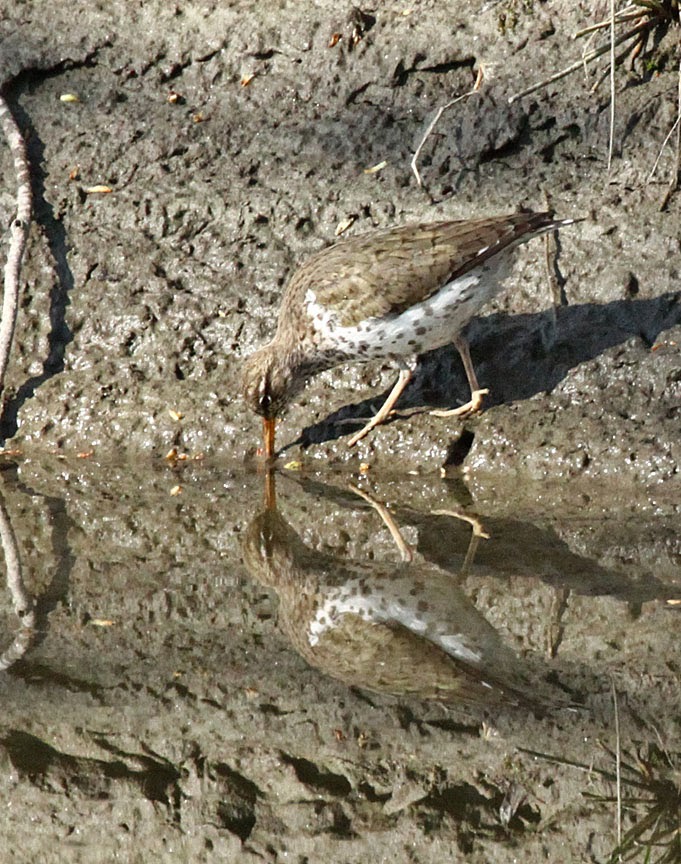
This spotted sandpiper was almost perfectly camouflaged against the bank of the Mill Brook, at Dummerston Landing.

American redstart
The American Redstart flashes the bright patches in its tail and wings. This seems to startle insect prey and give the bird an opportunity to catch them.

caught a bug!

warbling vireo
 Easy to locate by his song, the rhythm of the warbling vireo's song goes like this - "if I see you, I will seize you, if I squeeze you, you will squirt"!

warbling vireo
Warbling vireos are always described as being a small, drab bird.
  
song sparrow
Song sparrow's song consists of 3 short notes followed by a varied trill, sometimes interpreted as "Madge-Madge-Madge, put-on-your-tea-kettle-ettle-ettle".

Saturday, May 17, 2014

Blue-Gray Gnatcatchers at Their Nest

We happened to see blue-gray gnatcatchers at their nest and Gerry got some great shots. Here's some interesting facts I found on Cornells's site, All About Birds.

Both sexes cooperate in building the neat, open, cuplike nest. They take up to two weeks to build the 2–3-inch wide nest, which is held together and attached to its branch with spider webbing and decorated with lichen.

 The nest's high walls are built in flexible layers. The main structural layer is built of fibrous materials like plant stems, bark strips, and grasses, all held together by spiderweb or caterpillar silk.

Inner layers become progressively finer, and the roughly 1.5-inch-wide cup is lined with plant down, paper, cocoons, hair, or feathers.

The outside is covered with webbing or silk decorated with bits of lichen or bark flakes.

  They often build a series of nests during a summer to counteract the effects of predation, mite infestations, or cowbird parasitism.
 Materials from earlier nests are frequently recycled to build later nests, which may be why they are usually completed more quickly than first nests.

 The male often builds second nests nearly solo, with the female finishing the inside of the first nest with softer materials.

 time for a break!!


Saturday, May 10, 2014

Spring at Herrick's Cove

Baltimore Oriole

 Finally spring has arrived, the weather's been warmer and the birds are returning to Herrick's Cove in Bellows Falls!. It's nice to see the bright colors of the Baltimore orioles!

Gray catbirds are now everywhere and chatting up a storm! Here's a good look at his rusty red undertail coverts.

gray catbird


Blue-gray gnatcatchers are very small birds with long tails which they flick from side to side. They are always in constant motion.  

yellow-throated vireo


The best bird of the day was a pair of yellow-throated vireos. They were so close to us, Gerry had a hard time getting a picture in focus with his zoom lens! 

Another bird Gerry has been after for a good picture, this female pileated woodpecker was very cooperative today!

An immature bald eagle was keeping watch along the Williams River. One can never see enough of these majestic birds!


Saturday, May 3, 2014

Bald Eagles - Herrick's Cove

A morning spent at Herrick's Cove in Bellows Falls gave Gerry a great opportunity to get images of bald eagles. Here's a beautiful adult flying overhead, (there's a nest with young up the river a bit).

This immature bald eagle had just eaten lunch (fish) and was perched in the cove. The nearby Canada geese didn't seem to be concerned as they swam closely by.

Maybe they knew he had just eaten!?!?

When the eagle finally took off, they honked relentlessly!!
Enjoy the pictures!


Saturday, April 26, 2014

Spring Migrants at Herrick's Cove

ruby-crowned kinglet
One of the smallest songbirds, the ruby-crowned kinglet has been singing up a storm this spring. His song starts out with 4 or 5 high pitched notes, followed by a warbling repertoire of sounds that only gets louder as he sings!

Ruby-crowned posing pretty!
Our other kinglet, the golden-crowned (click on the link to read my posting), is around in the winter. Only hummingbirds are smaller than these songbirds.

osprey
Herrick's Cove is a favorite stop for osprey, where they can be observed hanging in the air or "kiting" over the water, then diving, feet first, for a fish.

great blue heron
Another common bird is the great blue heron, showing how he tucks his long neck when he flies.

bufflehead

Here's a cool fact about buffleheads; they nest almost exclusively in holes excavated by Northern Flickers and, on occasion, by Pileated Woodpeckers.

palm warbler
Palm warblers are quite common in the spring, with their rusty colored caps and habit of bobbing their tail.

northern flicker
This flicker is probably looking for ants, its preferred food.

Friday, April 18, 2014

Snowy Owl in April!

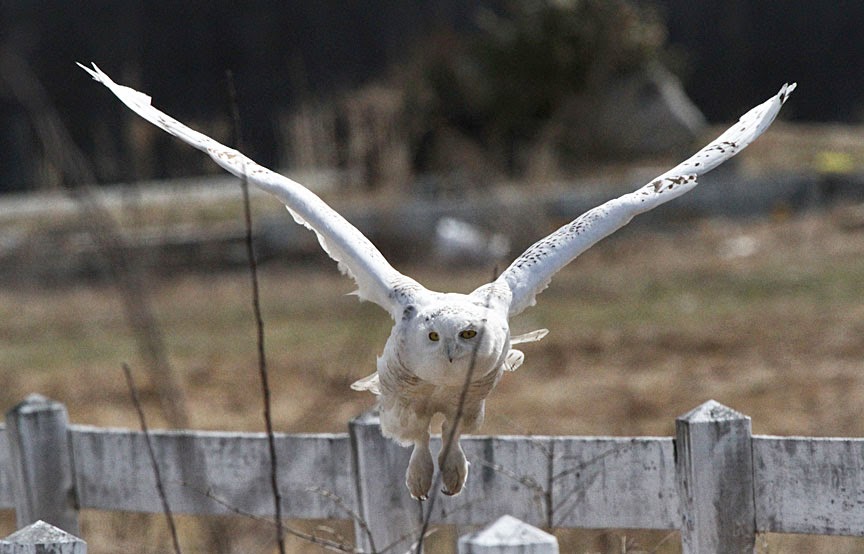
 There was a report of a snowy owl in North Springfield, Vermont yesterday, not too far from home. We found it quite easily at the corner of route 106 and route 10, perched on a white fence, exactly where it had been reported!.

Sitting not more than 40 feet from the busy intersection, the owl seemed pretty relaxed and not affected by the noise of the traffic.

We didn't even get out of the car, certainly didn't want to spook it. The owl sat on the post for a while, then flew even closer to us!


Gerry just held his finger on the shutter. The camera has a "burst" mode and takes 8 frames per second! A snowy's wingspan is between 4.2 and 4.8 feet.


It's usually a rare site to see a snowy owl, but this winter and spring, these beautiful birds of the Arctic tundra are still around!