Saturday, May 10, 2014

Spring at Herrick's Cove

Baltimore Oriole

 Finally spring has arrived, the weather's been warmer and the birds are returning to Herrick's Cove in Bellows Falls!. It's nice to see the bright colors of the Baltimore orioles!

Gray catbirds are now everywhere and chatting up a storm! Here's a good look at his rusty red undertail coverts.

gray catbird


Blue-gray gnatcatchers are very small birds with long tails which they flick from side to side. They are always in constant motion.  

yellow-throated vireo


The best bird of the day was a pair of yellow-throated vireos. They were so close to us, Gerry had a hard time getting a picture in focus with his zoom lens! 

Another bird Gerry has been after for a good picture, this female pileated woodpecker was very cooperative today!

An immature bald eagle was keeping watch along the Williams River. One can never see enough of these majestic birds!


Saturday, May 3, 2014

Bald Eagles - Herrick's Cove

A morning spent at Herrick's Cove in Bellows Falls gave Gerry a great opportunity to get images of bald eagles. Here's a beautiful adult flying overhead, (there's a nest with young up the river a bit).

This immature bald eagle had just eaten lunch (fish) and was perched in the cove. The nearby Canada geese didn't seem to be concerned as they swam closely by.

Maybe they knew he had just eaten!?!?

When the eagle finally took off, they honked relentlessly!!
Enjoy the pictures!


Saturday, April 26, 2014

Spring Migrants at Herrick's Cove

ruby-crowned kinglet
One of the smallest songbirds, the ruby-crowned kinglet has been singing up a storm this spring. His song starts out with 4 or 5 high pitched notes, followed by a warbling repertoire of sounds that only gets louder as he sings!

Ruby-crowned posing pretty!
Our other kinglet, the golden-crowned (click on the link to read my posting), is around in the winter. Only hummingbirds are smaller than these songbirds.

osprey
Herrick's Cove is a favorite stop for osprey, where they can be observed hanging in the air or "kiting" over the water, then diving, feet first, for a fish.

great blue heron
Another common bird is the great blue heron, showing how he tucks his long neck when he flies.

bufflehead

Here's a cool fact about buffleheads; they nest almost exclusively in holes excavated by Northern Flickers and, on occasion, by Pileated Woodpeckers.

palm warbler
Palm warblers are quite common in the spring, with their rusty colored caps and habit of bobbing their tail.

northern flicker
This flicker is probably looking for ants, its preferred food.

Friday, April 18, 2014

Snowy Owl in April!

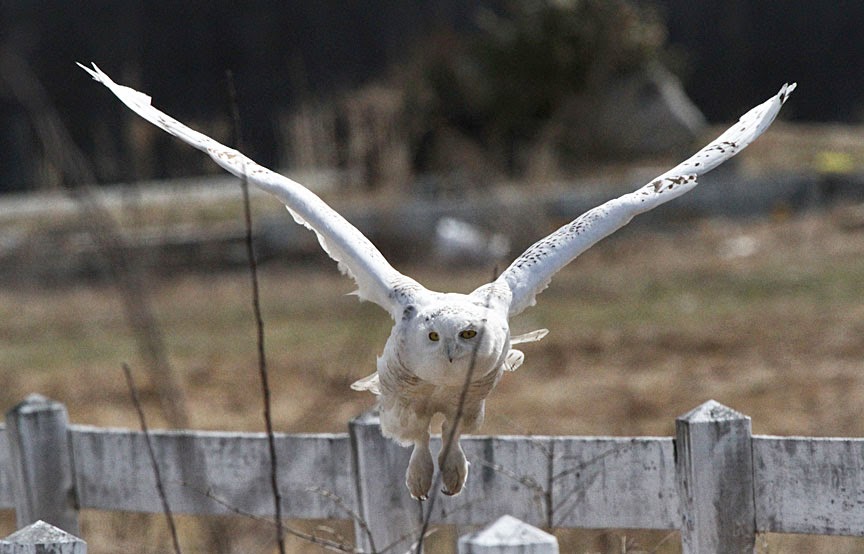
 There was a report of a snowy owl in North Springfield, Vermont yesterday, not too far from home. We found it quite easily at the corner of route 106 and route 10, perched on a white fence, exactly where it had been reported!.

Sitting not more than 40 feet from the busy intersection, the owl seemed pretty relaxed and not affected by the noise of the traffic.

We didn't even get out of the car, certainly didn't want to spook it. The owl sat on the post for a while, then flew even closer to us!


Gerry just held his finger on the shutter. The camera has a "burst" mode and takes 8 frames per second! A snowy's wingspan is between 4.2 and 4.8 feet.


It's usually a rare site to see a snowy owl, but this winter and spring, these beautiful birds of the Arctic tundra are still around!


Sunday, April 6, 2014

Ross's Goose

Snow Goose and Ross's Goose

I read the Vermont list serve (reports bird sightings) and saw that Ken Cox had just reported seeing a Ross's Goose at the waste water treatment plant in Charlestown, New Hampshire. I jumped in the car and raced over there!! The Ross's was still present with 15 snow geese.

A small, white goose with black wingtips, the Ross's Goose is a miniature version of the more abundant Snow Goose. It breeds in the central Arctic and winters primarily in central California, but is becoming more frequent farther east. 


Sunday, March 30, 2014

Speculum Feathers in Mallards

Speculum, Latin for "mirror", refers to the patch of iridescent color on the secondary feathers (wings) of most duck species. 

Both male and female mallards show this feature, edged in white.

On a drab winter's day, the purple-blue-violet color is a welcome sight!

This is an excellent feature to distinguish a mallard from an American black duck in flight. Since both ducks are the same size and shape, it's good to know the black duck's dark blue to purple speculum is without white borders.


Thursday, March 27, 2014

Symbol of the Sun: Raptors and Us

bald eagle

Last Saturday, the Nature Museum in Grafton hosted a presentation by Michael Clough from the Southern Vermont Natural History Museum (SVNHM). Mike's talk was titled "Symbol of the Sun: Raptors and Us" and explored the relationship between humans and birds of prey that goes back thousands of years

red-tailed hawk
The program included an interactive slideshow about our history with raptors. He brought a bald eagle, American kestrel, red-tailed hawk and a saw-whet owl that SVNHM cares for, all are recovered from injuries but unable to be released back to the wild.

 A recent addition to SVNHM, this female bald eagle was hit by a car in Wyoming and will be used in the museum's educational programs. She's very impressive although only weighs 11 pounds.

northern saw-whet owl
Equally impressive is our smallest northeastern owl (this one with a permanent eye injury) who weighs between 3 and 5 ounces!

If you missed the presentation, go to the Herrick's Cove Wildlife Festival in Bellows Falls on Sunday May 5th from 10am to 4pm. Michael Clough will be there with raptors and other wildlife from the Southern Vermont Natural History Museum in Marlboro, Vermont, located on Route 9. Or just go visit the museum!